The 0Maths blogFor dyscalculic students:
Our not wrong, but perhaps not yet right approach helps students re-engage if they've had struggles in maths. Sometimes that's enough, but we can go much further where needed (and, yes, we can tell you where greater foundational depth is needed).
From the SASC definition:
“A specific learning difficulty in mathematics is a set of processing difficulties that affects the acquisition of arithmetic and other areas of mathematics.” My italics
- it's crucial to note that dyscalculia is a set of difficulties, not just one thing.
We spot the following in pupils' answer data:
- Understanding quantity (non-symbolic magnitude)
Some pupils have a less precise intuitive sense of “how many”, making it harder to estimate or compare amounts without counting. This is closely linked to:
- Linking numbers to meaning (symbolic processing)
Some struggle to connect numerals (e.g. 7) to the quantities they represent. This is one of the most common and persistent barriers.
The good news is that these difficulties can be mitigated with work. We have around 50 activities specifically for dyscalculia.
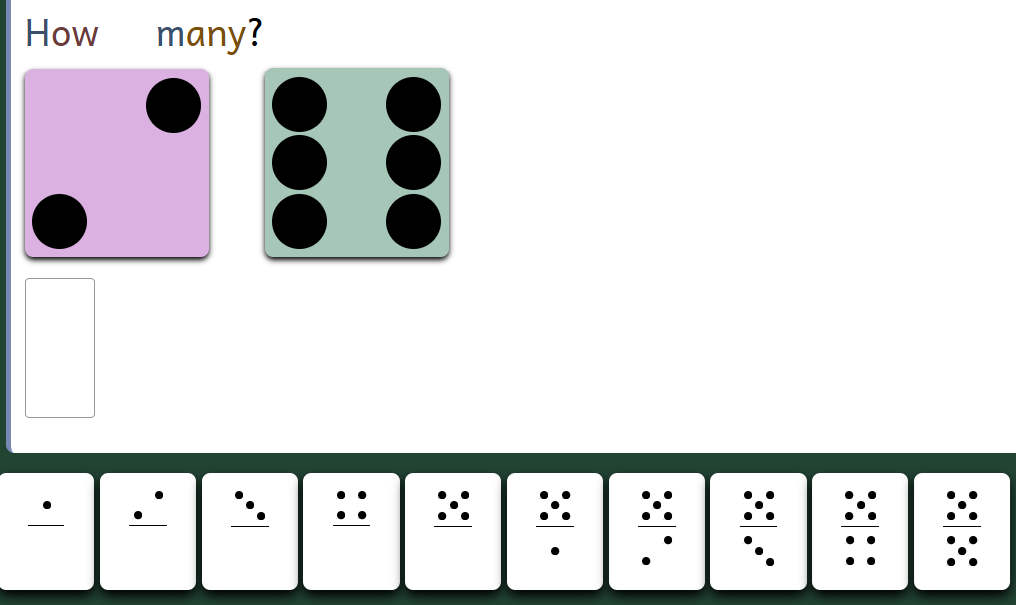
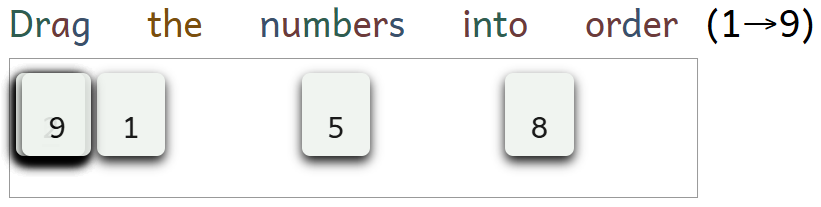
All of them are backed by findings in psychology research. For example, the part of the brain that processes numbers in a neurotypical individual is connected to the intraparietal sulcus, the part of the brain that is used for spatial and visuomotor integration movements (eg reaching, throwing and catching). This makes sense when you think of the complex maths needed to predict a ball's path through the air and catch it. We can use this in activities to embed the connection where it's absent, by forcing students to drag the 9 further than they drag the 8 for example and so on.
 .
.
There are other difficulties that come under the dyscalculia umbrella, and they require a different approach:
- Maths anxiety - see separate section.
- Reduced working memory - presenting exercises to reduce working memory demands helps all learners, as does encouraging students to consider problems visually.
Our overall approach is designed to lower cognitive load. For the most part, the below refer to how 0maths works out of the box; they are not specific adaptations.
- We offer simplified arithmetic levels for most question types, so numeracy difficulties have a limited impact on understanding other concepts.
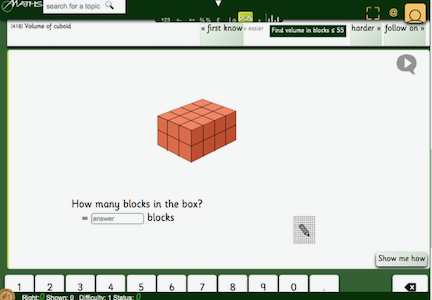
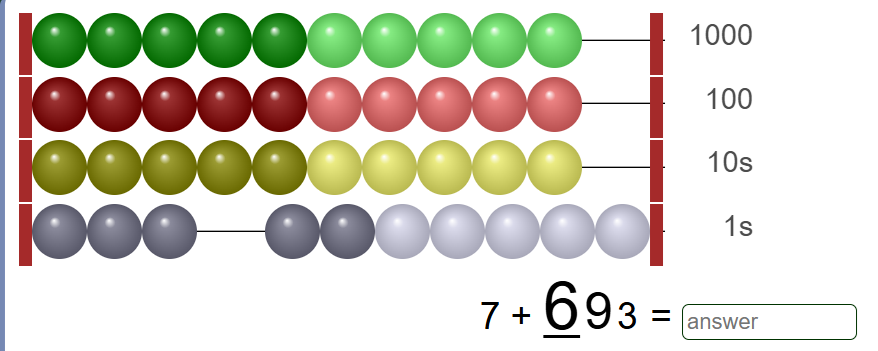
- Visual representations are shown where appropriate.
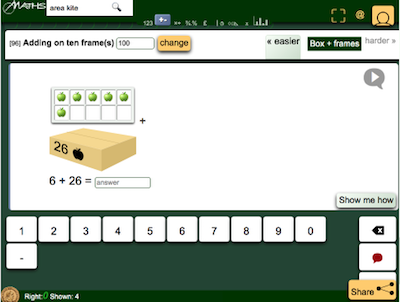
Note also, in the above example, the specific visual representation discourages adding by counting from zero - something dyscalulic students are inclined to do.
- Optionally, aids such as the hundred square or times tables grid can be made permanently available to a student for all questions, not just multiplication / division. We place them at the start of the questions, so that the pupil has to scroll to and from the lookup table. This is to make it increasingly more effort than calculating, requiring the answer to be held in short term memory while the pupil scrolls.
- Learners persist with wrong answers. This is far more useful than being told they're wrong.
- Small steps. For example, when students are learning to add 2 digit numbers, they are taken through the following steps, proceding when they can answer each stage without an error:
- Adding units only without crossing ten;
- Adding 10s only;
- Adding units to make up a 10;
- Add 10s and units to make up a ten;
- Add units crossing 10;
- Add random tens or units;
- Add two fully random two-digit numbers, with a visual aid / widget;
- Add two random two-digit numbers with no aids;
- Each step of multi step problems can be marked.
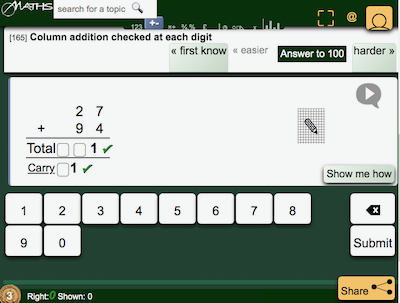
- There are no time limits.
- Links to definitions mean vocabulary is never a barrier.
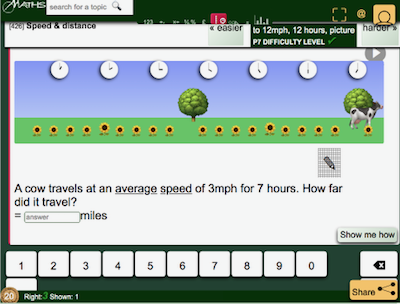
- Hints for common gotchas.
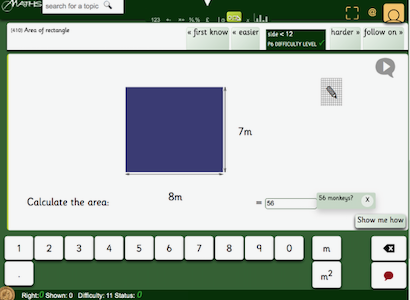
In the above example, the hint is '56 monkeys?' if the user has answered 56 and not altered their answer for 20 seconds. They would also get a hint ("Read the question more carefully") if they answered with the perimeter instead of the area, for instance.
- Previous answers are accessible for reference / confidence.
- Students are encouraged to retreat to foundation topics if gaps in their knowledge require it.
- We also screen entered answers for indications of dyscalculia, and automatically suggest relevant exercises, and adpatations (for example, if a pupil is mixing up 6 and 9, we'll underline 6; if they are having problems with place value, we'll size the digits by place value).
 Nurturing maths awesomeness